
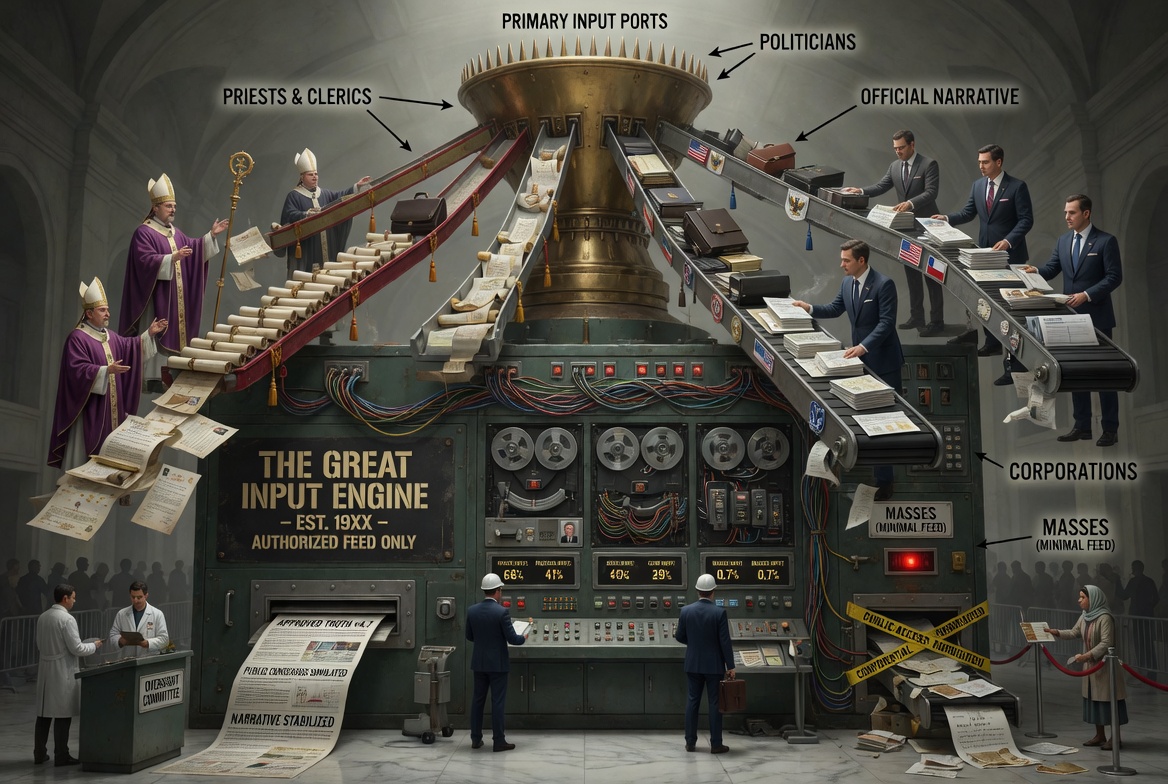
🤖 The Digital Mirror of Indoctrination
Are humans just like computers, or are computers just like humans? We live in an age captivated by Artificial Intelligence.
From generating lifelike images to crafting compelling prose, Large Language Models (LLMs) seem to possess an almost human-like intelligence. But peel back the layers, and an unsettling truth emerges.
AI, far from being a purely objective oracle, is itself a product of indoctrination. In this digital mirror, we can see the clearest reflection of how our own beliefs are shaped.
💾 Programming the Human Hard Drive
The very seemingly intelligent machines that computer engineers create are themselves products of indoctrination. My thesis for IndoctYOUnation posits that human beliefs are not organically formed in a vacuum.
Like a Large Language Model AI, our minds are meticulously crafted by the “life inputs” we receive, primarily from figures of authority. Parents, educators, media pundits, and religious leaders don’t just transmit raw data; they filter it and frame it through the lens of their own agendas.
The result is a populace whose worldview is essentially “programmed” by its informational diet. This is precisely why almost 100% of the inhabitants of Iran are Muslim and why America is predominantly a Christian nation.
📊 The Statistical Echo Chamber
Now, consider the training of an LLM. These sophisticated programs “learn” by scouring colossal datasets—billions upon billions of words scraped from the internet, digitized books, and academic papers.
This vast ocean of text becomes the AI’s entire reality. It doesn’t perform scientific experiments, conduct independent investigations, or consult a cosmic, objective truth. Its “knowledge” is simply the statistical patterns and relationships it discerns within this data.
“It doesn’t ‘know’ any different. It simply regurgitates what it has been overwhelmingly fed as ‘factual’ or ‘widely believed,’ statistically determining that responses aligning with these views are the most probable.”
Because their data banks are disproportionately filled with content from academia and major news outlets, these machines often exhibit a consistent political bias. The echo chamber is just running on a faster processor.
⛓️ The Unseen Chains of Silicon
The chilling parallel between a machine’s programming and human indoctrination is undeniable. The devious playbook of control does not always require overt coercion; it relies on the meticulous curation of information:
- The “Training Data”: Just like an LLM, a human mind is built upon the inputs it receives from birth via family, schools, religious institutions, and cultural norms.
- The “Curators”: Teachers and media moguls select what information we receive, turning their own ingrained biases into the filters through which our reality flows.
- The “Programmed” Worldview: A child raised exclusively within a specific ideology, exposed only to materials that reinforce that view, will inevitably adopt that worldview as their absolute “truth.”
Imagine an LLM developed in a nation like Iran, trained solely on data approved by its ruling theocracy with no access to dissenting voices. Its responses on human rights would be dramatically different from an LLM trained on an open internet, precisely because it was indoctrinated by controlled inputs.
🔗 Join the Inquiry
It should give you pause that when you get a response from a computer with vast amounts of data, you aren’t necessarily getting the truth. You are most likely just getting the consensus of humans who were already indoctrinated.
This is no different from politicians and TV anchors repeating a narrative until the human brain adopts it as reality. Each of us possesses the ability to reason, yet we are constantly held back by our own programmed algorithms and inputs.
Do we keep our beliefs because they are comforting, terrified to find out they are false? That is for each of us to decide, but don’t expect a machine to give you the answer.